Audit recommendations implemented
The 2024 Audit Impact Report compares Portland’s implementation rate with 64% among responding peer cities. The comparison uses each reporting framework’s measures.
City Auditor source ↗
ENGINEERING IN SERVICE OF PEOPLE
Better systems.
Stronger communities.
Evidence everyone can use.
We believe engineering has a public purpose: to make complex systems understandable, accountable, and useful to the people who depend on them.
AI-generated illustration inspired by Portland’s waterfront.
OUR RESPONSIBILITY
SALAR Technologies LLC is an Oregon engineering company. The same discipline we bring to reliable electronics—trace the evidence, understand the failure, measure the result—also shapes our contribution to society.
We share independent research that helps residents, public servants, businesses, researchers, and community organizations examine difficult questions together. Publishing this report openly is one practical expression of that commitment.
Offer this complete study free, in plain language, with its sources available for scrutiny.
Keep human dignity, privacy, uncertainty, and fair treatment at the center of the discussion.
Connect proposed solutions to accountable owners, practical milestones, and visible outcomes.
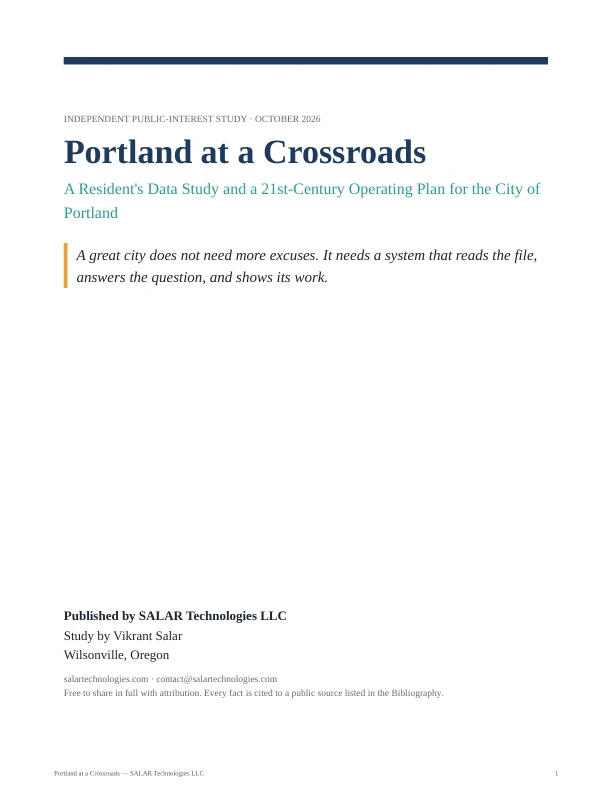
FEATURED PUBLIC-INTEREST RESEARCH · OCTOBER 2026
A Resident’s Data Study and a 21st-Century Operating Plan for the City of Portland
By Vikrant Salar, Founder & Principal
SALAR Technologies LLC · Wilsonville, Oregon
This independent study brings together public audits, government data, regional reports, and published reporting. It examines how Portland and the region are governed, where delivery falls short, and what a more accountable operating model could look like.
PDF · 6.85 MB · October 2026 edition. Share the full report free with attribution.
Public-source analysis and the author’s proposals. Reported facts, interpretations, and estimates have distinct roles; the proposed operating plan is not an adopted City program.
THE CASE FOR BETTER DELIVERY
The report’s central argument: public institutions need a clearer connection between money, decisions, and outcomes. Start with evidence, then test the proposed fix.
The 2024 Audit Impact Report compares Portland’s implementation rate with 64% among responding peer cities. The comparison uses each reporting framework’s measures.
City Auditor source ↗The 2025 report records 617 eligible complaints, up from 469 in 2024. This is a measure of demand; a complaint is not itself a substantiated finding.
Ombudsman source ↗Portland’s FY2024–25 report counts 34,766 public requests and 19,711 government requests. These categories together make the total.
Legal Records Team source ↗Dated source snapshots, not live indicators. The study explains differences in definitions, geography, reporting periods, and counting methods.
Fragmented systems and handoffs make it difficult to follow a resident’s request or establish who owns the next step.
A shared case identifier, a governed records index, and an audit trail across participating bureaus—the report’s proposed City “Data Spine.”
Track transfer time, unresolved cases, and whether residents can see status without repeating their story.
Chapter 22 ↗Fees and repeated searches can make public information difficult to obtain, even when routine requests close quickly.
Publish frequently requested releasable records once, test search and redaction assistance with human approval, and evaluate a no-fee policy for individual residents.
Publish median and 90th-percentile response times, costs, repeat-request rates, and review errors.
Chapter 23 ↗Rising demand creates pressure on complaint handling, investigation capacity, and meaningful explanations for residents.
Define triage paths, publish anonymized outcomes and reasons for declining cases, and assess staffing against actual caseload.
Track case age, time to resolution, referral outcomes, and implementation of recommendations.
Chapter 24 ↗Spending, shelter capacity, housing placements, and long-term stability are different measures. Changing count methods complicate comparisons.
Align City, county, and Metro responsibilities; improve secure person-level coordination and bed information; pilot contracts tied to durable housing outcomes.
Report housing exits and retention, returns to homelessness, inflow, and data quality with privacy protections.
Chapter 25 ↗Publishing an audit does not guarantee that its recommendations become operational improvements.
Launch “PortlandStat”: a recurring public performance review, with an owner, due date, and status for open recommendations.
Track evidence of closure, overdue actions, service outcomes, and completeness of published baselines.
Chapter 27 ↗Modernization depends on people, sustainable funding, and a transparent account of costs and trade-offs.
Develop a small digital-service team and civic fellowships, publish hiring baselines, test AI in bounded pilots, and evaluate tax-policy options openly.
Track time to hire, pilot accuracy, total cost, and distributional impacts before expanding programs.
Chapters 26–28 ↗FROM RESEARCH TO PRACTICAL ACTION
Begin with published baselines and accountable owners. Test small, measure the results, then scale what works. These are proposed milestones from Chapter 29, not completed projects.
Evidence: public baselines and named owners.
Evidence: working pilots and published error rates.
Evidence: measured changes from baseline.
Evidence: an independently reviewable record.
The report’s cost figures are SALAR estimates with stated assumptions. Implementation would require public decisions, budget review, responsible data governance, and validation of benefits.
Read the roadmap, ownership tables, and cost assumptions · pp. 225–230 ↗FOR STAKEHOLDERS
Residents deserve understandable answers. Public teams need workable improvements. Both need evidence they can examine.
Share the study with colleagues, neighborhood groups, public-service teams, researchers, and business leaders. Start with the summary, choose one service problem, and use the chapter sources to test its proposed solution.

SALAR TECHNOLOGIES LLC
Our contribution begins with open research and a commitment to clear, accountable engineering.
Download Portland at a Crossroads ↓