01 / CHOOSE
Which AI fits the job?
Match research, coding, document review, numerical work, and local deployment to appropriate tools. Compare accepted work, human review, latency, and full delivery cost.
Too many tools. Too many promises. Which AI helps you finish the work—and which businesses can keep delivering?
Our study connects model capability with the things that decide whether it is useful in practice: evidence, cost, cyber resilience, hardware, and the people who remain responsible for the result.

An AI tool can write a convincing response and still leave the difficult work unfinished: checking the source, correcting the calculation, reviewing the code, or recovering when something fails.
Choosing AI That Lasts asks a practical question: what does an accepted result cost, and what makes the system dependable enough to keep using? It then examines the market behind the tools—integrated platforms, frontier model services, open-weight ecosystems, and specialist applications.
The full study brings together primary research, original mathematical analysis, reproducible numerical scenarios, and six worked engineering cases. The public white paper presents the main findings and selected figures.
Match research, coding, document review, numerical work, and local deployment to appropriate tools. Compare accepted work, human review, latency, and full delivery cost.
Keep evidence and permissions attached to the workflow. Examine prompt injection, tool authority, patch timing, common failures, and recovery.
Assess distribution, differentiation, sustainable delivery, maintenance, and portability. Use conditional scenarios through 2031 and observable signs that would change the outlook.
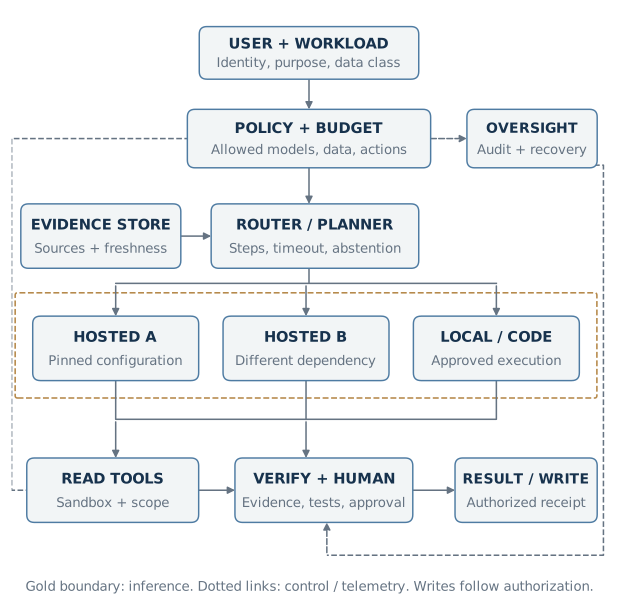
The proposed architecture connects a defined task to trusted evidence, an admissible model or numerical tool, independent checks, and an authorized result.
It asks what each component may read, what it may change, and who can verify the outcome. Multiple models are evaluated as an option whose benefits must justify the added complexity.
| Business model | A path to endurance | What to watch |
|---|---|---|
| Integrated platforms | Distribution, dependable infrastructure, identity and useful workflow integration. | Full cost, concentration, switching effort and demonstrated customer value. |
| Frontier model services | Capability and product quality that buyers continue to value. | Repeatable task advantage, reliability, pricing power and sustainable delivery. |
| Open-weight ecosystems | Maintained artifacts, flexible hosting and useful adaptation. | Actual licenses, serving economics, maintenance and support. |
| Specialist applications | Distinct data, trusted integration or a measurable workflow advantage. | Customer retention, implementation burden and ease of substitution. |
These are conditional research judgments. The study distinguishes a company’s survival from a product’s continued availability and an ecosystem’s technical usefulness.
The question is whether the system delivers work you can accept, at a cost you can sustain, with a way to recover when conditions change.
Read the central argument, architecture, selected calculations, business-model outlook, and references. The short edition draws directly from the completed 156-page study.
Contact SALAR Technologies LLC for the full research edition, including the detailed models, case studies, methods, bibliography, and supporting analysis. Tell us your organization and the part of the study you would like to discuss.
Founder & Principal
vikrant@salartechnologies.comWilsonville, Oregon
contact@salartechnologies.com